Why Food and Heritage Experiences Go Hand in Hand in Delhi
Delhi is not a city you simply visit. It is a city you absorb, one street at a time, through its monuments, its people, and most importantly, its food. The moment you step out into its lanes, history does not sit quietly behind glass walls. It simmers in kadhai, rises with steam from early morning kitchens, and lingers in the air long after the last plate is cleared. Food stops in Delhi are never just about hunger. They are extensions of the city’s memory, shaped by migration, survival, and everyday rituals that have been repeated for generations.
From Mughal kitchens to post-Partition refugee settlements, Delhi’s food culture has grown alongside its history. Every iconic Delhi food carries with it a story of adaptation and resilience. To understand the city fully, one must eat where the city eats, not in isolation, but as part of its lived heritage.
Where to Eat After Visiting Central Delhi Landmarks
Central Delhi landmarks often leave visitors in quiet awe. After walking through historic corridors, shaded avenues, and old markets, the instinct to pause and reflect naturally leads to food. Not refined dining, but something grounding. Something local. Old Delhi food places have long served this purpose, offering meals that feel like a continuation of the city’s rhythm rather than a break from it.
For decades, travellers, office workers, pilgrims, and students have followed the same unwritten routine. Visit a landmark. Walk a little further. Eat something honest and filling. Local eateries in Delhi thrive because they understand this rhythm. They do not compete for attention. They wait patiently, confident that those who know will arrive.
In areas close to central landmarks, breakfast becomes especially significant. Early mornings see queues forming outside modest storefronts, where food is prepared the same way it was years ago. This is where Delhi food culture feels most intimate, shared across generations and backgrounds without ceremony or pretence.
A Taste of Delhi’s Food Heritage at Sita Ram Diwan Chand
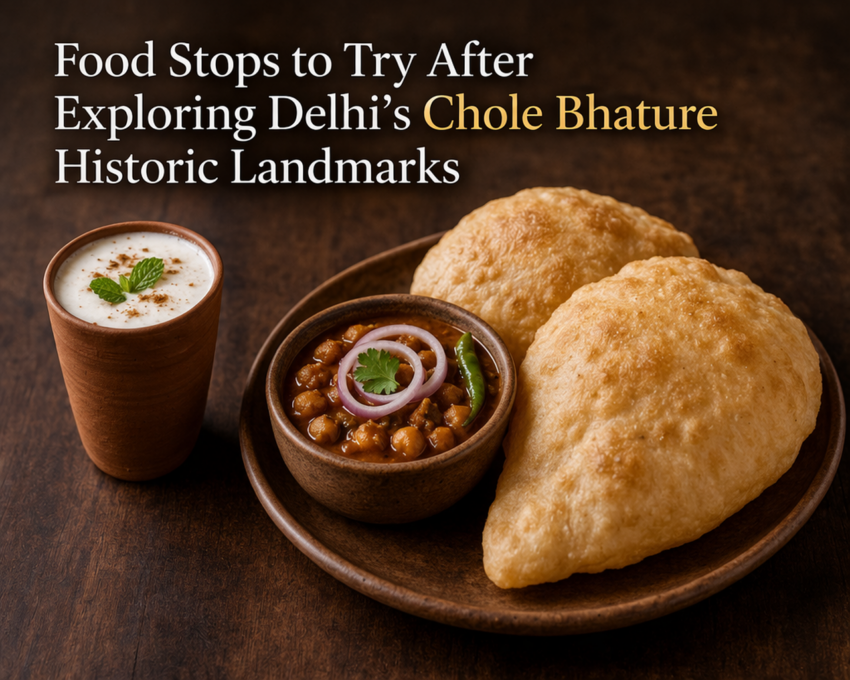
Among the many food stops in Delhi that have quietly shaped the city’s culinary identity, Sita Ram Diwan Chand occupies a place of deep respect. Its story begins in 1950, when Shri Sita Ram Kohli started selling chole bhature from a small pushcart near DAV School in Paharganj. What began as a necessity soon became a reputation, built not through advertising but through consistency and trust.
Over the decades, as Delhi expanded and tastes evolved, Sita Ram Diwan Chand chose restraint over reinvention. The chole remained slow-cooked, deeply spiced, and balanced without excess heat. The bhature continued to be hand-rolled and fried to a texture that feels light despite its indulgence. Regulars still recognise the familiar aroma at the Chuna Mandi outlet, where mornings unfold the same way they always have, with shared tables and unspoken rituals.
This is why Sita Ram Diwan Chand is often spoken of in the same breath as iconic Delhi food. It is not because it claims to be the best, but because it has never tried to be anything else. In a city constantly changing, its steadiness feels rare. Eating here is not about nostalgia alone. It is about experiencing how Delhi has fed itself for generations, without compromise.
Tips for Tourists Choosing Food Stops in Delhi
For visitors navigating Delhi’s vast food landscape, the abundance can feel overwhelming. The key lies in understanding how locals choose where to eat. The most trusted local eateries in Delhi are rarely loud or flashy. They are places where people return out of habit, not novelty.
Timing matters. Breakfast spots often tell you more about a city than late-night indulgences. Watch who is eating there and how long they have been coming. Listen to the silence between bites. In Delhi, that silence often signals satisfaction.
Another important cue is simplicity. Menus that have remained focused over decades usually do so for a reason. When a place dedicates itself to one dish and perfects it, the food carries a confidence that needs no explanation. Old Delhi food places, in particular, reward those who slow down and observe, rather than rush from one recommendation to the next.
For those unable to visit in person but curious about maintaining that connection to Delhi food culture, Sita Ram Diwan Chand has quietly extended its presence beyond its physical locations. Their ready-to-eat offerings are designed for people who miss that familiar taste, whether due to distance, time, or travel, without altering the essence of the original recipe.
Wrapping up
Delhi reveals itself slowly. Through early mornings, shared tables, and meals that refuse to be rushed. Food stops in Delhi are not destinations to be ticked off a list, but moments that anchor memory to place. Old Delhi food places, in particular, remind us that heritage is not always preserved in monuments alone. Sometimes, it lives in a bowl of chole, served the same way for decades.
Sita Ram Diwan Chand continues to be part of this living heritage, not by chasing trends, but by honouring routine, patience, and flavour built over time. Whether you walk in after visiting a landmark or reach for that familiar taste from afar, the experience remains rooted in the same quiet promise. This is how Delhi remembers itself. Through food that endures, and places that never forget why they began.